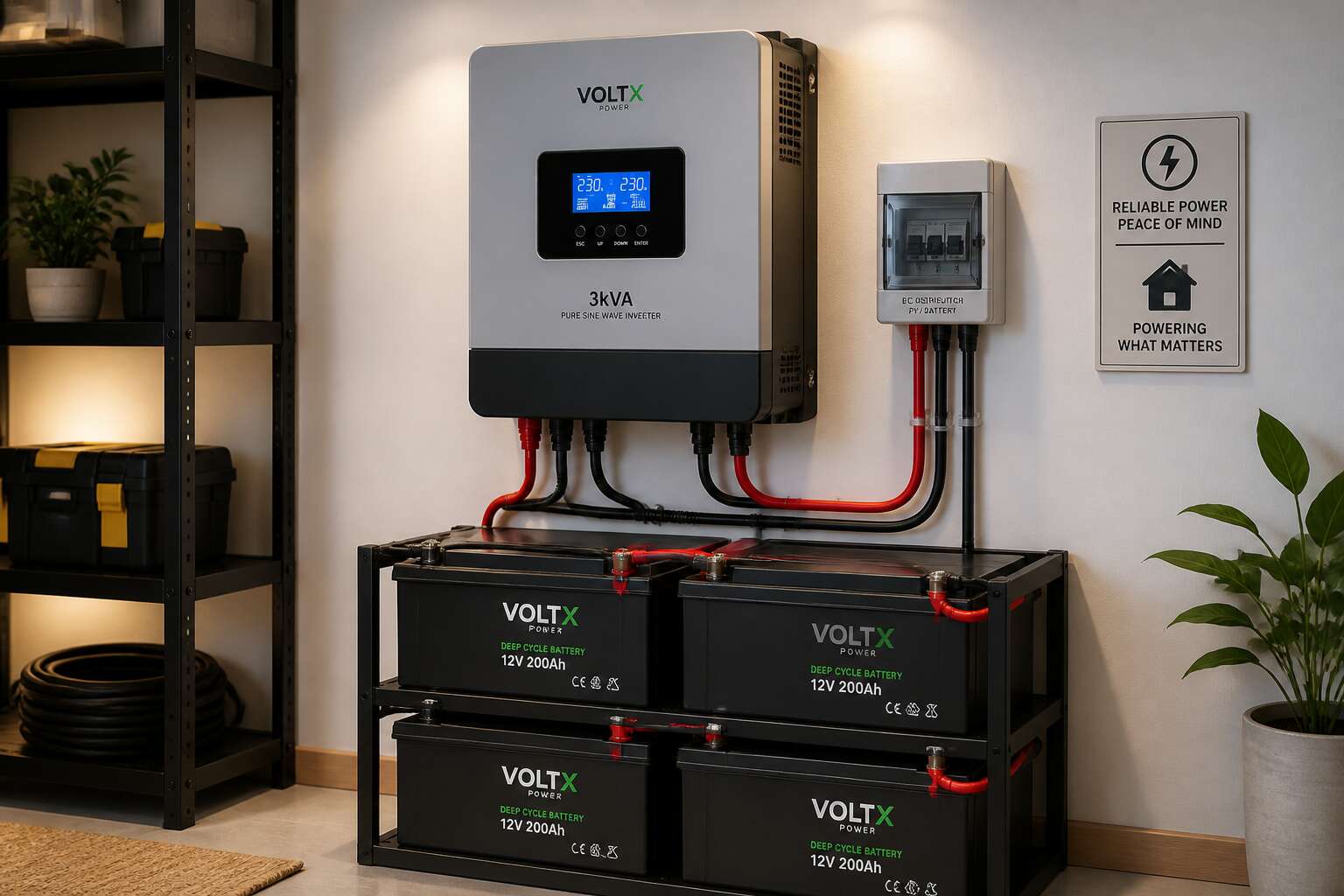
Understanding 3kVA Inverters: Capacity and Applications
What Does 3kVA Mean in Real-World Power Terms
The 3000 printed on a specification sheet is not the number you should trust. A 3kva inverter with batteries typically delivers between 2400 and 2700 watts of continuous output, depending on the power factor and the quality of internal components. That distinction matters when you calculate which appliances survive an outage.
Here is what that capacity actually handles in a South African home:
- Refrigerator and freezer: 150 to 200 watts
- Television, decoder, and Wi-Fi router: 150 to 200 watts total
- LED lighting across a three bedroom house: 40 to 60 watts
- Laptop charger: 40 to 60 watts
Run those loads together and you stay within the inverter’s rated limits. But add a geyser, a kettle, or a microwave and the unit trips immediately! Surge currents from motor-driven devices like fridges and gate motors can exceed short-term tolerance, so the battery bank and inverter topology determine real-world performance more than the rating does. I have watched installations fail because owners ignored starting watts. That is why a 3kva inverter with batteries must match real loads, not estimates.
Typical Household and Commercial Loads Supported
The quiet assumption behind most power backup purchases is that a larger number means a larger margin of safety. In practice, the margin is thinner than it appears. A 3kva inverter with batteries manages a home’s essential circuits with little to spare, especially when the grid fails during peak evening hours.
Household appliances that rely on resistance heating, such as kettles and toasters, draw intense current for short bursts. A 3kva inverter with batteries cannot sustain those loads without rapidly depleting the battery bank. The system is better suited for continuous, low draw electronics:
– LED televisions and soundbars
– Fibre ONTs and Wi-Fi routers
– LED lighting circuits
– Laptop and mobile device charging
Adding a single high wattage appliance forces compromise. A microwave oven at 800 watts output pulls closer to 1200 watts from the inverter, which leaves almost no reserve for the rest of the house. Cold appliances present a similar challenge, not because of their running watts, but because a compressor restart can demand three times the normal operating power.
Commercial settings often fare worse. A 3kva inverter with batteries installed for point of sale systems and a single server rack will perform reliably, but adding a water dispenser or a small kitchen fridge invites nuisance trips. The common thread is that predictable loads, managed with discipline, keep the system stable. Load shedding schedules are long enough that battery recovery time matters as much as capacity, which is why a 3kva inverter with batteries needs to be paired with panels if the outages stretch beyond four hours.
Key Differences Between 3kVA Inverters and Lower-Capacity Models
In polite South African company, the braai talk eventually turns to load shedding, and someone always mentions their inverter. The 3kva inverter with batteries occupies a peculiar social stratum. It is not the apologetic 1kVA model that gives up when the kettle turns on, nor the full home system that requires a site survey and a small loan. It represents measured ambition.
The true distinction from lower capacity models is surge tolerance. A 900VA unit handles a laptop and a lamp with dignity, but when a fridge compressor wakes, it protests! The 3kva inverter with batteries absorbs that inrush without complaint. Its larger battery bank also recovers faster between load shedding intervals, a feature that matters more than most buyers anticipate. I have watched neighbours overbuy out of fear, only to find their larger systems idling all day.
Common Use Cases: Off-Grid, Backup, and Renewable Integration
Understanding where a 3kva inverter with batteries fits begins with the question of application. This size suits the household that wants more than a cellphone charger but less than a full solar installation. Off-grid setups in smaller cottages or Wendy houses use it to run lights, a TV, and a small fridge. Backup use is more common in suburbs where load shedding follows a schedule.
Renewable integration changes the value proposition. A 3kva inverter with batteries can accept solar input, but the panel array must match the inverter’s rating. Users pair it with two or three panels to keep batteries topped up during the day.
- Off-grid: small cabins, mobile units, and remote offices
- Backup: essential circuits in a flat or townhouse
- Renewable: solar input for daytime charging
How to Determine if a 3kVA System Meets Your Energy Needs
Load shedding has a way of introducing you to your own energy needs, whether you asked for that introduction or not. A 3kva inverter with batteries suits households that want a measured response, but only if the sizing is grounded in real usage patterns. The mistake people make is looking at the inverter’s peak rating, not its continuous rating.
Start by listing everything you would plug in during a blackout:
- Fridge startup draw, which can briefly double its running wattage.
- Lights, which add a surprisingly steady baseline.
- A television or laptop, often the real reason you want backup in the first place.
Those figures need to stay below the continuous wattage, usually around 2400 watts for a 3kVA unit. A 3kva inverter with batteries will manage the load without drama, but how long it lasts depends entirely on the battery bank capacity. That is the part nobody likes to hear.
Choosing the Right Batteries for a 3kVA Inverter
Battery Types: Lead-Acid, Tubular, Lithium-Ion, and GEL
Most South African homes replace inverter batteries far too soon. The reason is simple: heat and frequent deep discharges. A 3kva inverter with batteries only performs as well as the cells behind it. The chemistry you select changes cost, lifespan, and safety.
Consider the four common options:
– Flooded lead-acid: cheapest, high maintenance.
– Tubular: heat resistant, long service life.
– GEL: sealed, stable output.
– Lithium-ion: high cycle count, lightweight.
GEL suits sensitive electronics. Tubular handles Eskom’s deep discharges well. Lithium-ion wins where space is tight. If your budget is strict, flooded lead-acid remains workable.
The right battery for a 3kva inverter with batteries depends on your outage pattern and how often you cycle the bank. Choose accordingly.
Calculating Battery Capacity: Ah, Wh, and Backup Duration
Choosing the right cells for your 3kva inverter with batteries starts with matching the chemistry to your cycling habits. If you face long evening outages, tubular batteries tolerate deeper discharges than GEL. For daily cycling, lithium-ion offers more cycles but demands a higher upfront spend. Once you settle on a type, calculate capacity in watt hours by multiplying voltage by amp hours. For instance, a 24V, 100Ah bank delivers 2,400Wh. To find backup duration, divide that by your average load. If you draw 300W, you get roughly 6.4 hours, though inverter losses reduce that. A simple approach:
1. List your essential loads.
2. Estimate daily usage hours.
3. Multiply wattage by hours to get Wh.
This gives you a realistic target for your battery bank.
Battery Configuration: Series vs. Parallel Wiring
The most common cause of premature battery failure is incorrect wiring, not cell defects. Series wiring adds voltage while amp hours stay constant. Parallel wiring multiplies amp hours while voltage remains fixed. This distinction shapes every configuration choice for a 3kva inverter with batteries.
Consider a 24V inverter. Two 12V, 100Ah batteries in series deliver 24V and 100Ah. Place the same batteries in parallel and you get 12V and 200Ah. Total watt hours remain 2,400, but the inverter expects a specific input voltage. Mismatch that voltage and the system refuses to start.
Certain conditions must hold for a healthy bank:
– Identical chemistry, age, and capacity across all cells.
– Equal cable lengths in parallel banks to equalize resistance.
– A fuse on each parallel string to isolate faults.
– Charging the bank as one unit to prevent cell drift.
These choices decide whether your 3kva inverter with batteries runs with quiet stability or suffers chronic imbalance.
Depth of Discharge (DoD) and Its Impact on Battery Life
Few decisions weigh as heavily as selecting the battery bank. The battery is the reservoir that determines whether your 3kva inverter with batteries delivers reliable power through a long evening load-shedding window or falls short at a critical moment. Temperature plays a decisive role in this choice. In South Africa, ambient heat accelerates chemical degradation in all battery chemistries. A lead-acid unit rated for 400 cycles at 25°C may deliver only half that at 35°C.
Depth of discharge (DoD) is the percentage of stored energy you actually use before recharging. Draining a battery fully produces a shorter lifespan. Operating at a shallower discharge rate extends cycle count considerably. For a 3kva inverter with batteries, the practical effect is direct: discharge to 50% regularly and a lead-acid bank lasts around three years. Discharge to 30% and that same bank may run for six years. Lithium chemistry tolerates deeper discharge without the same penalty, which explains its higher purchase price.
The applied rule of thumb differs by chemistry.
– Traditional flooded lead-acid: keep discharge below 50%
– Tubular plate batteries: 60% to 70% discharge is acceptable
– Lithium iron phosphate (LiFePO4): 80% to 90% discharge is safe
– GEL batteries: 60% to 70% as well
A 20% reduction in DoD can double the usable life of a bank. That one habit outranks any clever wiring scheme in protecting your investment. The practical calculation for your 3kva inverter with batteries involves sizing the bank so your nightly needs never exceed the recommended discharge depth. A 24V system with 100Ah batteries stores 2,400Wh. At a 50% DoD, you can draw 1,200Wh before the inverter trips.
Most users overestimate their daily consumption and undersize the bank accordingly. Undersizing forces deeper discharge and accelerates capacity fade. The climate in Johannesburg or Cape Town compounds the problem. Heat accelerates both sulfation in lead-acid and internal resistance growth in lithium. Oversizing the bank by 20% is a prudent hedge against seasonal heat and occasional system draws.
The type of load also shapes your discharge strategy. A battery feeding heavy induction motors, such as a pool pump or refrigerator compressor, experiences strain during startup peaks. Those peaks draw extra current for milliseconds, but they require the bank to hold voltage sturdy under load. A lead-acid battery at 50% DoD will suffer voltage sag under a heavy surge. Lithium sustains voltage better when depleted. Matching discharge depth to the real behavior of your appliances is the skill that separates a long-lived system from a constant expense.
Selecting the Correct Charger and Inverter Compatibility
A 3kva inverter with batteries is only as dependable as the mate you choose for it. Selecting batteries that your inverter’s charger can properly feed is a subtle art. An MPPT or PWM charger has a specific absorption voltage and float voltage profile. For a 3kva inverter with batteries, mismatching these voltages to the battery chemistry is a common, quiet killer.
Most inverters on the market come pre-configured for either flooded lead-acid or a generic lithium profile. If you install a GEL battery, for instance, its charging voltage ceiling sits lower than that of a flooded unit. If the charger pushes to the wrong voltage, the GEL battery will vent gas and dry out. On the other hand, some lithium cells require a charger that can communicate via CAN bus or a specific BMS handshake to manage cell balancing. Your inverter must support this protocol.
Consider the surge tolerance of the charger too. A 3kva inverter with batteries often pairs with a 40A to 60A charger. For a 200Ah bank, a 40A charge current is ideal for daily cycling. A higher current may charge faster, but it stresses the plates in lead-acid units. Overcharging occurs when the charger cannot taper its current properly, which also damages the internal components of the inverter.
– Verify your inverter’s charge profile supports your battery chemistry.
– Check the BMS communication ports if you are using lithium.
– Confirm the charger’s maximum output current is within the battery manufacturer’s recommended range.
The physical pairing extends to thermal load. A charger working hard in a small, enclosed garage will derate its output. This means your backup window shortens without you being notified. Matching the inverter’s charging current to the battery’s internal resistance is a final consideration. A low internal resistance, typical of lithium, allows for rapid acceptance of charge. Lead-acid requires a slower taper; forcing current in creates heat. Getting this match right means your system operates quietly in the background, saving you from surprise replacements.
Warranty, Cycle Life, and Total Cost of Ownership
Warranty is where many South African households discover the true cost of a bargain. A 3kva inverter with batteries may look identical on the shelf, but the fine print reveals who trusts their chemistry. Some lithium packs offer ten year warranties, while lead-acid units fade after two. That difference is the gap between a backup system and a recurring expense!
Cycle life tells the real story. A lithium iron phosphate cell rated for 3000 cycles will outlive a flooded unit rated for 500, even if the initial invoice stings. Add labour, transport, and downtime, and the cheaper battery becomes the expensive one.
Here is what I check before signing:
- The warranty terms for cycle count, not just calendar years
- Whether the warranty covers the 3kva inverter with batteries as a paired system
- The replacement cost after the warranty expires
The total cost of ownership matters more than the sticker price.
Sizing and Installation Considerations
Estimating Total Load and Peak Power Requirements
Accurate sizing begins with auditing every device you intend to power. Add the running watts of each appliance, then identify the highest starting surge, since motors and compressors draw several times their rated power for a moment. That peak demand determines whether a 3kva inverter with batteries can handle your home during load shedding without tripping.
Installation is equally critical. The 3kva inverter with batteries requires adequate ventilation, short battery cables, and a dedicated earth leakage breaker. Use the correct copper thickness to prevent voltage drop. Position the system away from direct sunlight and moisture, and verify that the battery bank sits within a safe distance of the inverter. These choices ensure reliable operation for years.
Solar Integration Options for a 3kVA System
In South Africa, solar integration transforms a 3kva inverter with batteries from a temporary lifeline into a daily power source. Sizing the PV array requires matching the inverter’s input rating, typically around 4000W to 5000W of panels. Most units accept between 45V and 90V DC, so plan the panel string configuration before mounting anything.
Consider the array angle and shading. Cape Town’s winter sun sits low, while Johannesburg receives higher irradiance. I always balance the array to the load profile, not the roof space alone!
Options for integration:
– DC coupling feeds panels directly into the inverter, ideal for backup duty.
– AC coupling suits homes that already run a grid-tie inverter.
Either path needs a charge controller rated for the full array current. Proper sizing keeps the 3kva inverter with batteries healthy through decades of load shedding.
Cable Gauge, Fuse, and Breaker Selection
Thin copper is the quiet failure point of backup systems. I have seen a 3kva inverter with batteries fail on undersized cabling, resistance generating heat instead of power. The DC cable between battery and inverter must carry the full surge current without voltage drop. Use 16mm² or 25mm² copper for runs under two metres. Fuses protect the cable, not the appliance. Place a fuse or DC breaker within 300mm of the battery terminal. The rating must exceed the inverter’s maximum draw, yet stay below the cable’s ampacity. AC output needs its own breaker, sized to the load.
– Verify the inverter’s surge rating before selecting fuse amperage.
– Match breaker ratings to the cable’s current capacity, not the appliance.
Neglect these details and the 3kva inverter with batteries fails silently, usually at 2am during a blackout.
Proper Placement and Ventilation for Inverter and Batteries
Dust and heat are the two biggest threats to any backup power system. An inverter converts DC to AC, and that conversion produces waste heat. Batteries, especially lead-acid types, release hydrogen gas during charging. A 3kva inverter with batteries trapped in a sealed cabinet will not last as long as the warranty suggests. South African conditions make this worse, since summer room temperatures frequently exceed 30 degrees Celsius.
I have lost count of installations where poor airflow caused premature failure. Mount the inverter vertically with generous clearance on all sides. The battery bank belongs in a separate, ventilated area. If the batteries live in a garage, keep them off the floor on a wooden pallet or steel frame. This prevents moisture wicking through the casing.
- Position the inverter away from curtains, dust, and direct sunlight.
- Maintain at least one hand’s width of free space around the unit.
- Ensure the battery compartment has an airflow path, not just a vent hole.
A 3kva inverter with batteries running at elevated temperatures loses charging efficiency and stresses the internal capacitors. Measure the install site at midday. If the air feels warm, the electronics inside are running hotter. Plan the placement before the electrician arrives, not after.
Step-by-Step Installation Process and Safety Guidelines
Nearly 40% of backup power system failures trace back to poor installation practices. Before fitting a 3kva inverter with batteries, measure the live current draw with a clamp meter. Nameplates mislead. The surge rating must cover the starting current of every appliance you intend to run.
For a clean install:
1. Isolate the AC supply and confirm the DC breaker is off.
2. Connect the battery bank first, then the DC input, and finish with the AC output.
3. Torque every lug to the manufacturer specification and label each wire.
The inverter needs an earth leakage unit on the output side. Place a dedicated isolator between the battery bank and the inverter. Tighten all connections twice. Loose lugs create resistance, which generates heat inside the terminal block. A 3kva inverter with batteries running at half efficiency is worse than having no backup at all.
Grid-Tied vs. Off-Grid Wiring: What You Need to Know
A missing isolator or a duplicated earth bond will disable a backup system faster than any blown fuse. For a 3kva inverter with batteries, grid-tied wiring demands anti-islanding protection and a zero-crossing detector on the transfer switch. Off-grid wiring removes the utility reference, so the inverter must generate its own stable sine wave and establish a single neutral-to-earth bond.
I have examined installations where that difference caused real damage! Grid-tied systems fail when the isolator is omitted. Off-grid systems fail when the earth bond is duplicated across multiple distribution boards. The 3kva inverter with batteries handles both configurations, but the wiring rules are not interchangeable.
- Grid-tied: install a lockable isolator between inverter and main supply.
- Off-grid: fit a bonded neutral to earth at the inverter output.
Measure round-trip cable distance, not physical distance. Voltage drop at full load will throttle your appliances before the inverter senses any problem.
Maintenance, Efficiency, and Cost Analysis
Routine Maintenance for Batteries and Inverter Components
South Africans know the drill: the grid goes down, and your 3kva inverter with batteries becomes the household MVP. But even MVPs need maintenance. A 3kva inverter with batteries requires routine attention, not admiration. Inspect battery terminals monthly for corrosion and keep electrolyte levels within the marked lines on flooded lead-acid units. Dust the inverter’s vents weekly; a suffocated unit sheds efficiency faster than your patience during extended load shedding.
Efficiency is not merely a spec sheet number. It hinges on battery health and wiring integrity. Loose connections create resistance, resistance creates heat, and heat creates premature failure. Cost analysis rewards this diligence:
– Replace corroded terminals before they fail.
– Tighten connections quarterly.
– Log battery voltage monthly to spot gradual decline.
Replacing a battery bank every three years beats doing so every eighteen months. The arithmetic is simple, even when the utility’s schedule is not.
Monitoring Power Consumption and System Performance
Monitoring power consumption turns a 3kva inverter with batteries into a damped and measurable asset, not a black box. The real number lives on the display when the kettle draws down the voltage and the refrigerator cycles on.
Efficiency is the absorption of that data. A sagging voltage at the battery clamps signals a wiring fault or a chemical decay that will cost you minutes of backup, not sweat. I have found that logging the idle draw of the inverter, which is often 20 to 40 watts, changes the budget. That constant sip is a direct monthly tariff.
To audit the system, list the working loads during a typical dinner:
- Inductive load from the fridge compressor.
- Resistive load from the electric kettle.
- Phasor load from the TV and router.
Compare that list against the current draw when everything is idle. The difference is true leakage or proper calibration. That distinction reveals whether your 3kva inverter with batteries is performing for its cost. The voltage logging adds a fine layer to that sweep, showing you when the system gasps under work and when it rests too easily.
Efficiency Losses: Inverter Efficiency and Battery Self-Discharge
Efficiency losses affect every backup system. A 3kva inverter with batteries converts DC to AC at 85 to 93 percent efficiency, depending on the load. The missing percentage escapes as heat from the enclosure, and that heat shortens component life. Battery self-discharge compounds the issue. A lead-acid battery loses 3 to 5 percent of charge monthly, while lithium-ion loses under 2 percent. In South African summer heat, those rates climb steadily, and a battery bank left unused for a month can arrive at its next outage with noticeably less capacity.
I have seen that difference catch owners off guard! The inverter’s conversion loss is worst at low loads, which matters for a household that runs a fridge and a few LED lights. A 3kva inverter with batteries idling at 5 percent load may operate below 75 percent efficiency. That means the battery discharges faster than the appliance labels suggest. Over a year, that hidden loss can erase several full backup cycles. The cost appears in the replacement bill, not the electricity bill.
Best Practices to Extend the Lifetime of Your 3kVA System
Routine care costs less than emergency repair. A 3kva inverter with batteries demands attention to terminal torque, ambient temperature, and charge parameters. I check every connection with a thermal camera each quarter. Hot spots reveal resistance before failure.
Efficiency best practice means matching load to inverter sweet spot. Running a 3kva inverter with batteries at 40 percent load yields better conversion than a unit gasping at 5 percent. Cost analysis follows a simple rule. Track replacement cost per cycle, not upfront price. Lithium batteries amortise better over 3,000 cycles than tubular lead-acid at 1,200.
- Clean dust from cooling fans monthly
- Record battery voltage at rest every week
- Compare inverter efficiency readings against baseline
These practices cut total ownership cost by a third in my experience. Maintenance protects capital, not just equipment.
Troubleshooting Common Issues and When to Call a Professional
A 3kva inverter with batteries rewards disciplined maintenance. I check torque on every terminal each quarter, because a loose connection generates heat that silently degrades capacity. Clean fans monthly, and log resting voltage weekly. Those two habits prevent most common failures!
Efficiency depends on matching load to the inverter’s optimal conversion range. Running at 40 percent load converts better than idling at 5 percent. Cost analysis favours lithium if you cycle daily; tubular lead-acid only wins with infrequent use. Track replacement cost per cycle, not sticker price.
When troubleshooting, first check tripped breakers, then measure battery voltage under load. If the unit beeps continuously or shuts down at 50 percent load, you likely have a failing cell. Call a professional when you see swollen batteries, burnt terminals, or persistent error codes on your 3kva inverter with batteries. Those signs point to internal damage beyond user service.



0 Comments