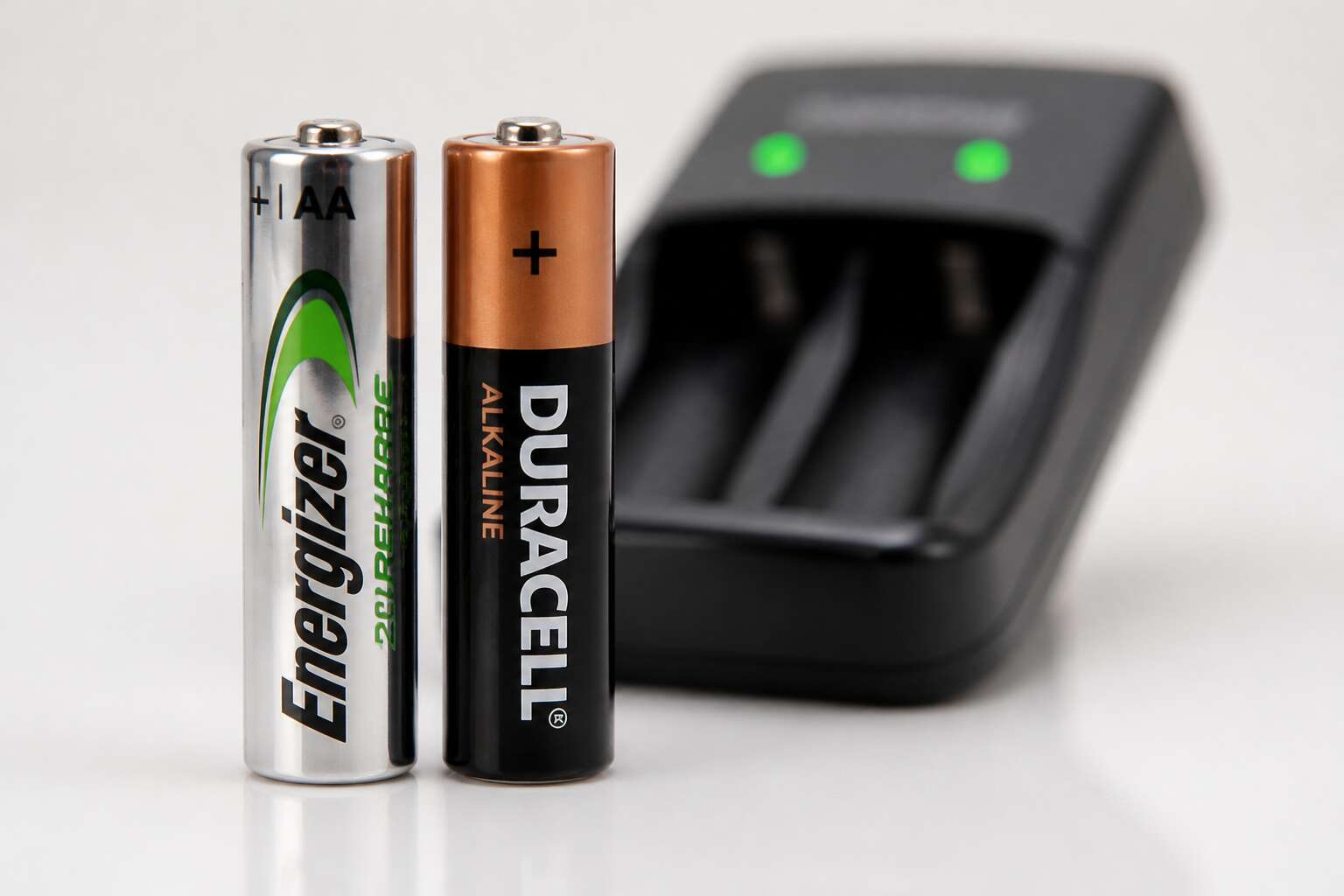
Battery Chemistries Explained
What Are Alkaline Batteries?
A standard alkaline cell loses about 2% of its charge each year while sitting unused. This low self discharge makes it reliable for emergency gear. The chemistry pairs zinc powder with manganese dioxide in a potassium hydroxide electrolyte, giving the cell its name and its steady 1.5 volt output.
For everyday items like remote controls or wall clocks, alkaline cells do the job. But they are single use. Once depleted, they cannot be recharged. That is where the debate between rechargeable batteries or alkaline becomes practical.
- If you power a torch for emergency use only, alkaline may suffice.
- If you cycle through batteries weekly, rechargeable nickel metal hydride saves money.
The choice between rechargeable batteries or alkaline rests on drain rate and frequency. Chemical reactions inside alkaline cells are not reversible in standard home chargers, so pushing current back in risks leaks or rupture.
How Rechargeable Batteries Work
Rechargeable cells depend on reversible reactions! Applying current forces the chemistry to reset, rebuilding the stored energy. In nickel metal hydride, hydrogen ions travel to the anode during discharge and return during charging. That cycle repeats hundreds of times.
Several factors influence how smoothly this works:
- Charge rate limits the speed of the reverse reaction
- Temperature extremes slow hydrogen movement
The real contrast with rechargeable batteries or alkaline holds in this reversibility. Alkaline cells suffer permanent changes once depleted. Rechargeable designs also self discharge faster, losing up to 20% per month. I find that tradeoff acceptable for regular use.
Key Differences in Voltage and Capacity
Voltage differences between chemistries matter more than consumers expect. A standard alkaline cell holds a nominal 1.5 volts, while nickel metal hydride rechargeable cells deliver only 1.2 volts. That gap determines whether a device runs at full brightness or shuts down early.
Capacity behaves differently. The milliamp hour rating describes total charge, not delivery speed. Some rechargeable batteries or alkaline cells post similar capacity numbers, yet discharge curves diverge sharply. Alkaline voltage declines gradually. Rechargeable cells hold a flat curve, then drop quickly.
Typical AA specifications:
- Alkaline: 1.5V nominal, 1800 to 2700 mAh
- NiMH: 1.2V nominal, 1900 to 2500 mAh
In my experience, devices built around 1.5 volts often switch off early with rechargeables, even when capacity appears comparable.
Self-Discharge Rates Compared
When choosing between rechargeable batteries or alkaline, I find self-discharge rates deserve attention. An idle alkaline cell can hold most of its charge for years. A standard NiMH cell, meanwhile, can lose a quarter of its stored energy within a month.
This gap matters if you keep spare cells waiting in a drawer. Modern low self discharge NiMH variants improve this! They still do not match alkaline in long term storage.
- Standard NiMH: up to 30 percent lost per month.
- Low self discharge NiMH: about 15 percent per year.
- Alkaline: about 2 percent per year.
For emergency torches or remote controls, the right answer depends on how often you are willing to swap cells.
Cost Analysis Over Time
Number of Recharge Cycles
Over 500 recharge cycles, a single rechargeable battery quietly replaces thirty alkalines. That is the kind of arithmetic your household budget appreciates.
When you compare rechargeable batteries or alkaline, the upfront price of a charger and cells looks steep. Yet the cost per use collapses with every cycle! An alkaline offers one discharge. A rechargeable offers hundreds.
- Alkaline: one cycle, then disposal.
- NiMH rechargeable: 500 to 1000 cycles.
- Lithium-ion rechargeable: 300 to 500 cycles.
From my own experience, friends toss out dead alkalines while their rechargeable counterparts sit through another charge. The real expense is not the single purchase. It is the repeated replacement. The choice reveals your patience with repetition.
Hidden Costs of Charging Equipment
The arithmetic of batteries rarely includes the equipment between the wall socket and the cell. When you compare rechargeable batteries or alkaline, the charger becomes a silent third party. A good charger draws nearly nothing once the cells reach full capacity. A cheap one keeps sipping power all night.
My own energy audit revealed that the hidden costs of charging equipment often amount to less than the price of a single alkaline. Yet those costs accumulate through standby lights, inefficient converters, and the occasional failed charger. I counted mine once:
- Standby power from a plugged-in charger
- Replacement of worn-out charging cables
- Higher electricity tariffs during peak hours
None of these expenses break a budget. But they tilt the equation further toward rechargeable batteries or alkaline, because rechargeables still pay for themselves after a handful of cycles.
Environmental Impact
Disposal Regulations and Landfill Risks
When rechargeable batteries or alkaline cells meet their end, the real cost begins. South African landfills receive millions of these power sources annually. Each discarded unit carries a silent payload of heavy metals and corrosive chemicals. Over time, weathering breaks down the outer casing. Cadmium and lithium compounds then migrate into soil and aquifers. This process rarely makes headlines, but it poisons ecosystems for generations. Disposal regulations like the Waste Act exist on paper. Practical enforcement, however, lags behind urban and rural realities.
- Compacted waste generates heat that accelerates battery corrosion.
- Rainwater flushes dissolved metals into surrounding groundwater.
- Local communities drawing from wells face long term exposure.
The distinction between rechargeable batteries or alkaline types matters little once buried. Both contribute to a legacy of leachate that outlasts their brief usefulness. This is no minor footnote in our consumption story.
Recycling Programs for Each Type
Recycling programs treat rechargeable batteries or alkaline very differently. In South Africa, dedicated facilities for rechargeable units recover cobalt, nickel, and lithium. Alkaline recycling remains scarce, with only a few collection points accepting them.
Consider what each program actually recovers:
- Rechargeable batteries yield valuable metals for reuse in new products.
- Alkaline cells often end up as inert filler or are processed for zinc and manganese.
My experience shows that urban residents have better access to drop-off sites. Rural communities rarely see these services. The environmental benefit depends entirely on participation rates!
Carbon Footprint of Manufacturing
Manufacturing any battery carries an environmental price. The production of rechargeable batteries or alkaline cells consumes raw materials and energy, though the scales are not equal.
Consider the numbers. Producing a single lithium-ion cell requires mining lithium, cobalt, and nickel. The energy draw is substantial! Alkaline cells need zinc and manganese, which are easier to extract but still disturb the land.
What surprised me during research? The upfront carbon footprint of one rechargeable battery is notably higher than a single alkaline cell. That fact alone discourages some buyers.
- Smelting and refining metals drive most factory emissions.
- Coal-fired grid power still runs many production facilities.
- Water use in mining creates local shortages.
Yet the long view matters more. One rechargeable cell replaces dozens of alkaline disposables. The embodied carbon debt clears after ten charge cycles. In South Africa, choosing rechargeable batteries or alkaline becomes clearer when you weigh manufacturing emissions across a full lifespan.
Energy Consumption During Charging
Charging a rechargeable cell carries its own environmental cost. The electricity that flows into the battery comes from a grid that, in South Africa, still leans heavily on coal. Roughly 80% of our power is coal-fired. Each kilowatt-hour you feed into a charger carries a carbon cost before it even reaches the battery. Efficiency losses add to that. A typical charger wastes 10 to 20 percent of the energy as heat. For every five units drawn from the wall, only four actually store themselves in the cell. The rest dissipates.
When you compare rechargeable batteries or alkaline cells, alkaline cells never demand this energy at the point of use. But the accounting must include the coal burned over years of recharging. If you recharge using solar panels, the calculation changes entirely. For many South Africans, that option is increasingly real. The decision hinges on where your electrons come from.
Sustainability of Raw Materials
Every battery begins with extraction. Lithium mining in the high Andes consumes vast reservoirs of groundwater. Cobalt from the Democratic Republic of Congo has a history of armed conflict and child labour. For rechargeable batteries or alkaline, the raw materials follow different paths. One digs deep for rare elements. The other uses zinc and manganese, more abundant but still mined from open pits that permanently alter the South African landscape.
The sustainability question turns on the lifespan of each cell. A rechargeable unit, used five hundred times, demands a single initial dig. Alkaline cells, spent once, require continuous digging. I see the difference in resource demand as stark!
- Rechargeable cells concentrate mineral extraction into one heavy removal.
- Alkaline cells spread the extraction across many shallow digs.
Neither approach leaves the ground untouched. The choice between rechargeable batteries or alkaline is a choice of which mining burden to accept.
Performance in Real-World Devices
High-Drain Electronics (Cameras, Toys, Flashlights)
A single high-drain device can reveal the true personality of a power source. We all know the frustration of a camera that dies at the precise moment of a perfect shot. In toys, the difference is even more pronounced. A remote-controlled car demands a sudden, violent surge of current to spin its wheels. An alkaline cell struggles to deliver that surge for long. The voltage collapses, and the car slows to a crawl long before the battery is technically empty.
This is where the choice between rechargeable batteries or alkaline becomes a matter of physics, not just preference. For a digital camera, the stakes are high. The motorized zoom and image processor are veritable energy monsters. Consider the performance in a real world scenario:
– A set of high-capacity rechargeable cells can capture several hundred shots of a full battery.
– Standard alkaline cells often manage less than half that number before the display flashes a low-battery warning.
– The rechargeable cells maintain a steady voltage, keeping the flash recycle time fast and consistent.
– Alkaline batteries suffer from a gradual voltage sag, which slows the flash and can shut down the camera entirely.
The same logic governs your flashlight. In an emergency, a dimming beam is an anxiety-inducing failure. A flashlight powered by lithium-ion rechargeable batteries or alkaline cells of the premium variety will burn bright initially. However, the alkaline’s light will lose its intensity over a short span. The rechargeable option holds a flat discharge curve, meaning the light stays just as brilliant until the very last moments of power. For a professional on a job site or a parent checking on a sleeping child in a Durban home, that sustained output is the defining feature. It transforms a tool into a dependable companion. The initial cost is higher, but the performance in these demanding tasks is the true measure of value. A toy that runs for twenty minutes on a disposable cell might run for three hours on a rechargeable one. The experience is not merely different; it is entirely superior when dealing with high-drain electronics. It is about having the power when you need it, without the sudden, silent surrender of a depleted alkaline. Whether you are navigating a path during load shedding or chasing a bee out of a Gauteng garden, the reliability of your tool depends on this choice. The magic is in the chemistry. That is the tale of power under pressure.
Low-Drain Gadgets (Clocks, Remote Controls)
The old farmhouse clock clung to its wall in the Kalahari, ticking with a certainty that outlasted every thunderstorm and heatwave. That reliability depends on a simple choice. Low-drain gadgets are the quiet workhorses of daily life, and their needs are different from a camera or a drill.
A kitchen clock, a television remote control, a wall thermostat, they all sip electricity in tiny, steady breaths. These devices operate for months or even years on a single set of cells. The differences in chemistry between rechargeable batteries or alkaline become less about raw power and more about longevity and pantry logic. Most people simply forget these devices exist until they stop working.
I recall a family in Limpopo whose universal remote for the satellite decoder was a prized possession. When they used rechargeable cells, they found themselves hunting for the spare pair every few weeks due to the higher self-discharge. The rechargeable cells lose their charge just sitting in the drawer. Standard alkaline, however, possess a remarkable chemical stability. They hold their energy for years, making them the superior choice for these undemanding tasks.
For these low-drain devices, the choice is clear:
– Alkaline cells are designed for a long, slow, and steady drain.
– They are cheap to purchase and require no forward planning.
– Rechargeable cells are a poor fit here, because they lose their charge just sitting on the shelf.
The practical reality involves convenience. Most of us want to fit a battery and forget it for a year. In a country where load shedding can reset our routines, the last thing you need is a wall clock that stops dead because the rechargeable cells depleted themselves without ever powering the hands. The debate between rechargeable batteries or alkaline often hinges on high-tech specifications, but in the kitchen, it is simply about the quiet certainty of timekeeping. It is about a remote that works during the final of the rugby match. That is the profound simplicity of a low-drain application. The power needed is minimal, but the endurance required is vast.
Extreme Temperature Behavior
In Upington, a car battery endures a harsh sun. In a Cape Town winter, a security gate remote waits in a cold passage. Extreme temperatures expose the difference between rechargeable batteries or alkaline. Alkaline cells handle moderate heat with composure, but freezing conditions slow their chemical reactions. Rechargeable batteries, particularly nickel metal hydride, lose capacity faster when the mercury climbs. They also suffer lasting damage when stored in a hot car. I have seen both types fail in field radios during a Northern Cape summer. A solar powered garden light needs dependable cycling. A backup sump pump demands cold start reliability. The right choice depends on your climate and your device.
Shelf Life in Emergency Kits
In real-world devices, the gap between rechargeable batteries or alkaline shows up fast. A digital camera demands bursts of power; a rechargeable cell copes, while an alkaline battery sags mid-shoot. A wireless mouse sips current for months, and alkaline gets the nod there. Match the cell to the appetite.
Shelf life in emergency kits tells another story. A torch parked in a load shedding drawer waits two years for the lights to fail. Alkaline cells hold that charge well. Rechargeable batteries drain themselves, silently, even when idle.
- Check expiry dates on alkaline packs before stocking a kit.
- Rechargeable batteries need a top-up every few months, even if unused.
The choice between rechargeable batteries or alkaline comes down to device habits and waiting time.
Smart Selection Strategies
Match Battery Chemistry to Device Needs
Every year, millions of usable cells are discarded because they were paired with the wrong device. The decision between rechargeable batteries or alkaline should follow the device’s pattern of use, not brand loyalty or shelf price.
Track the demand! A gadget that draws heavy current every day will exhaust alkaline cells quickly, while a device that wakes briefly once a month barely stresses its cells. The waste happens when chemistry and consumption are mismatched.
- Devices used several times weekly: rechargeable batteries support repeated use and reuse.
- Devices used once a month or less: alkaline cells require no charging routine at all.
South African households add grid instability and summer heat to the equation. I have watched a good battery reach the bin simply because its chemistry was chosen without regard for these conditions. The distinction between rechargeable batteries or alkaline, chosen with care, keeps devices working and keeps waste out of landfill.
Storage and Maintenance Best Practices
Studies on battery performance suggest that a single misplaced cell can lose up to 30 percent of its usable capacity through poor storage habits alone. That is a quiet drain of resources.
Smart selection begins with a deliberate audit of your actual routine. The human tendency is to stock a single type of cell for every purpose. Resist that pull. For a household powered by load-shedding schedules, the question of rechargeable batteries or alkaline is not theoretical. It is a question answered by your calendar of usage.
Once you have chosen, the maintenance phase demands a specific discipline.
– Store cells in a cool, dry place, away from direct sunlight.
– Remove rechargeable batteries from high-drain devices before long periods of inactivity.
– Check terminals for corrosion every few months.
Heat accelerates the chemical degradation of both chemistries. Ignoring this fact renders your careful choice useless. The final measure of a good battery is not the price tag at the counter; it is the functionality it provides at the end of its life. Make the conscious choice between rechargeable batteries or alkaline and treat that choice with respect.
Quality Indicators and Brand Reputation
I scrutinise packaging claims before committing. In South Africa, where loadshedding interruptions shape daily routines, the choice between rechargeable batteries or alkaline demands attention to the manufacturing date. A cell lingering on a retail shelf for two years represents a quiet loss of capacity. I check the stamped code on the casing. That habit has saved me from disappointment.
Quality indicators extend beyond expiry dates. The cell’s weight, the terminal seal’s tightness, the label’s print crispness, all reveal the manufacturer’s diligence. When comparing rechargeable batteries or alkaline options for my emergency kit, I favour brands that publish internal resistance specifications. That number tells me more than any marketing slogan!
Brand reputation rests on consistency. Some names earned their status through decades of reliable performance under demanding conditions.
- Review warranty terms for signs of confidence
- Compare capacity claims against independent test results
- Verify local availability of the model


0 Comments